The store
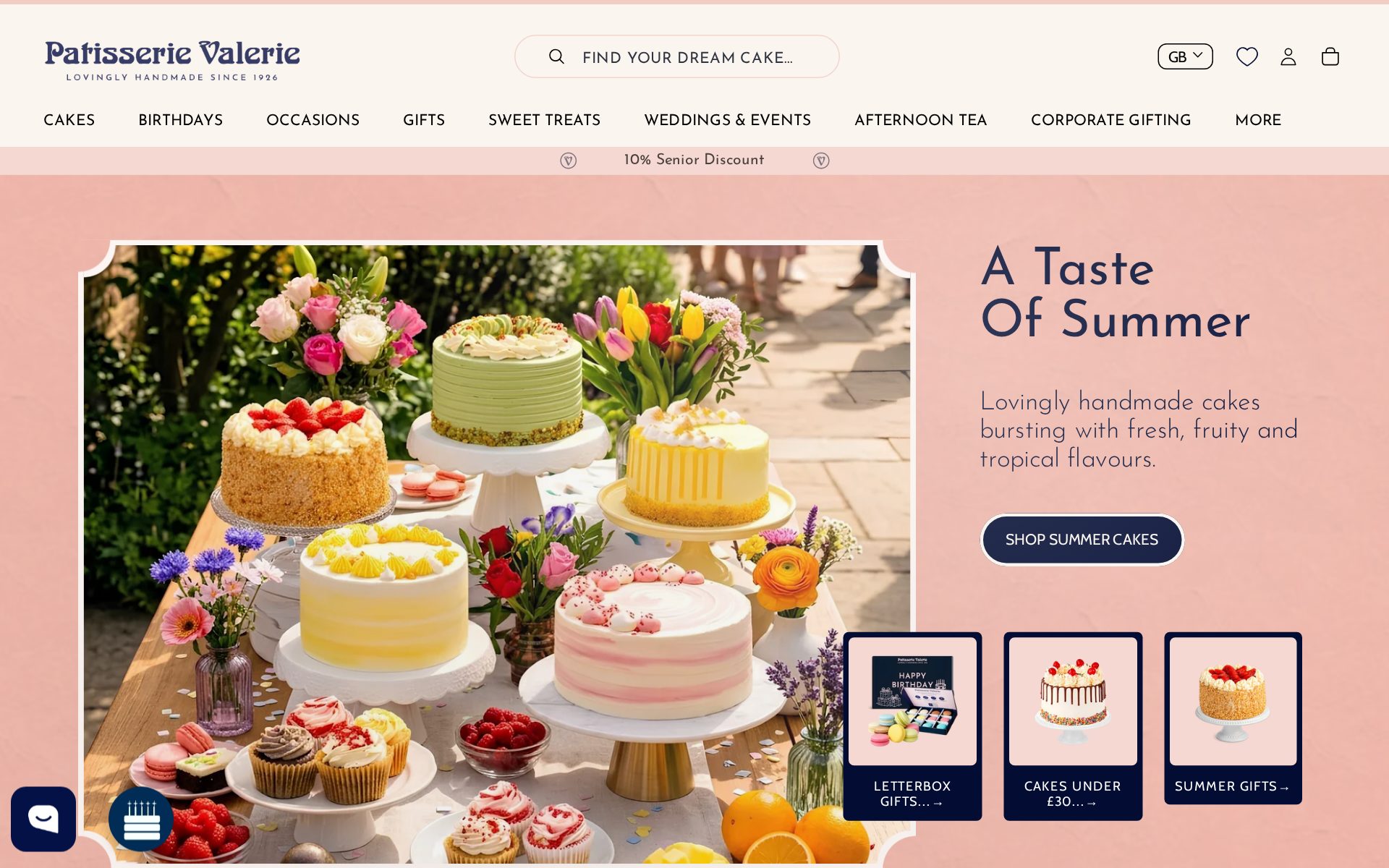
Patisserie Valerie has been baking since 1926, when Belgian pastry chef Theophile Vermeirsch and Esther Van Gyseghem opened on Dean Street in Soho to bring continental patisserie to London. The original shop was destroyed by bombing in 1943 and reopened on Old Compton Street; the business expanded across London through the 1990s and nationally from 2006. Online delivery launched in 2020, and direct delivery to Ireland followed in 2025. Their site cites over 40,000 customer reviews.
Celebration cakes, gateaux, cupcakes, macarons, gift boxes and hampers, afternoon tea, and party supplies — merchandised by occasion rather than by product type.
The customer questions
Occasion cakes are the least forgiving thing in e-commerce: a birthday cake that arrives on the wrong day has failed completely, however good it is. The logistics compound that. Cakes are baked, frozen, and shipped packed in dry ice; delivery runs Tuesday to Sunday but never Mondays or bank holidays; a whole cake needs at least six hours to defrost and must be eaten within four days. Cancellations are capped at a 50% refund inside 14 days and nothing at all inside 72 hours. Every one of those rules generates questions, and they arrive at roughly 160 a day — a volume no occasion-driven bakery can staff a rota against, least of all at the seasonal peaks when it matters most.
Recorded topic counts to 25 August 2026. A conversation may have more than one topic; this is not a mutually exclusive breakdown.
Why the question mix fits
The questions were high-volume but narrow: delivery windows, defrosting, dry ice, order changes, postcode coverage. All of it is written down in their policies already. What was missing was something that could give those answers at the moment a shopper asks, at 11pm on a Sunday, and escalate cleanly on the ones that genuinely need a person — a cancellation dispute, a damaged delivery.
This is Convi’s interpretation of the measured question mix and the store’s published information. It is not an account of the merchant’s internal decision-making.
From setup to live conversations
The recorded knowledge base contained 204 entries in the measurement snapshot.
The Convi team set up and configured their widget for them, working with the merchant through the 13 days between install and go-live.
The measured results
Across 15,156 conversations, 96.1% closed without escalating to a person — an average of about 159 a day. 583 conversations were handed to a human, which is the number that matters as much as the resolution rate: the assistant is not trying to absorb the hard ones. 413 orders included products it had surfaced. Shoppers wrote from 96 countries, and while the overwhelming majority wrote in English, the assistant also answered in Italian, German, French, Polish and Spanish.
median month, across 413 assisted orders since May 2026; measured to 25 August 2026. Assisted attribution describes involvement in an order, rather than sole causation.
Shopper markets
United Kingdom (14,122 conversations), Ireland, United States, India, Germany
Languages recorded
English, with Italian, German, French, Polish and Spanish also answered
The next area of focus
Question volume peaks around occasions and holidays, so the knowledge base is tuned seasonally ahead of the periods that generate the most contact.
Measured from Convi production data to 25 August 2026. Active stores with at least 50 conversations; internal test shops and sandbox traffic excluded. “Resolved without a handover” means the conversation closed without escalation to a human agent. Order attribution is assisted attribution — Convi is credited with influencing the order, not with being its sole cause.
This story uses historical data measured to 25 August 2026. It is a Convi analysis, not a merchant testimonial. A conversation closing without handover does not independently establish customer satisfaction.
Full measurement notes